


Community organizations that run donation drives have one constant, how to help as many people as possible with their available funds. Buying retail vs. wholesale is not a matter of a few dollars here and there. It’s the matter of funding that covers one drive for 50 families vs. 150 families.
The Numbers That Don’t Lie
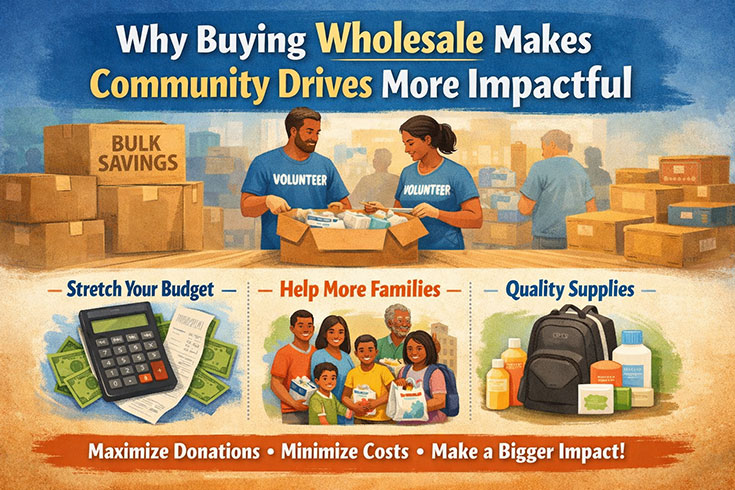
A food bank that buys hygiene kits at retail costs of $15 per kit has a budgetary stretch across a wholesale purchase that puts them at $5 or even $4 per kit. Numbers don’t lie. A $5,000 donation becomes 333 kits at retail and 1,000 kits through a bulk wholesaler. That’s 667 families receiving shampoo, deodorant, soap and other items who would otherwise not receive them all because someone made a better buying decision.
When looking for suppliers for donation drives, it’s critical to pick those who can supply wholesale. For instance, Bags in Bulk Canada offers a range of apparel and hygiene necessities at wholesale prices, so that the budget for the donation drive stretches further, aiding more people. For campaigns on a budget, this approach can really make a huge difference.
Reduced Storage Space Isn’t An Issue
One would think that buying wholesale means more volume so storage space is an issue. This is not true. When standardized packaging arrives for wholesale distribution, it’s easier to stack and take up less space than dozens of retail packaged items. This means volunteer coordinators spend less time trying to organize donations and more time getting items into people’s hands who can use them.
Additionally, the packaging matters. Wholesalers send items ready to go. There are no unwrapping of retail packaged pieces or spending time removing security tags. Everything is clean, organized and ready to go into distribution kits without hassle.
No Compromise on Quality
Another misconception is that wholesale means compromise on quality. This is not the case. Wholesale means selling the same products but without markup. The backpack that’s $35 at a retail store and $12 from a wholesaler is often the same exact backpack made on the same line in the same factory.
Smart organizations will get samples before making bulk purchases. They are not gambling on quality; they’re getting assurance that what they want to order, hundreds or thousands of, are reputable products before making any commitments. This keeps organizations in good standing and donors proud of what they’re giving to the less fortunate.
Consistent Supply Chains Maintain Programs
The problem with retail shopping means inconsistent access. One month the retailer has 20 winter coats in stock; the next week they’re sold out or not doing winter promotions anymore. Wholesalers keep stock year-round because they need to fulfill immediate business needs, not seasonal ones.
For organizations with ongoing distributions and programs, a homeless shelter who does supply distributions every month cannot tell clients “sorry, we couldn’t find any this month.” However, with a wholesaler supply in hand, consistent access to certain items is guaranteed without interruption.
Volunteer Hours Saved
Think about the number of hours volunteers spend going from store to store trying to make best of their dollar? This could instead be hours spent helping people directly. Buying in bulk makes buying easy. It’s one transaction for purchase versus shopping around. Place the order, set up delivery, get everything. Simple as that and that success saves volunteer energy for implementation rather than shopping care.
This saves even more time when organizations set up multiple drives throughout the year and don’t have to reinvent the wheel with each drive. Establishing relationships with wholesalers gets it done much quicker.
Budgetary Transparency Bolsters Donor Trust
Donors want to know where their funds go and how they make an impact. When organizations can relay that $100 helps 30 people instead of 10 because of wholesale purchasing, it goes further without question, literally.
There are no mixed messages when donor funds can go further by simply talking to wholesale programs about access. It makes fundraising easier when people know why and how their dollar can go so much further when it truly does. The reality is that it shows organization from an administrative standpoint where funds are being spent wisely.
Possible Lead Times
Retail buying means never having any idea what’s in stock down the road. Wholesalers work with different lead times and give organizations advanced notice about what’s stocked and what’s available on a more predictable scale.
This means organizations can plan quarterly or annually accordingly knowing they can get what they need when they need without issue.
They can also back up grant writing requests with accurate projections based on wholesaler prices instead of retail projections where items are day-to-day depending on what retailer carries what at any time.
The Bottom Line
Community support efforts rise and fall based on their ability to sustain help for those who need it most for as long as they need it. Buying in bulk removes financial obstacles and logistical redundancies that make programs less effective.
The savings are clear, but the operational advantages prove even bigger over time. Organizations who buy in bulk don’t just save money, they create sustainable programs that reach more people, waste less volunteer hours and show tangible value to donations and community supporters alike.
That’s the power of buying in bulk, taking limited resources and making them last through commendable community support that actually makes a difference.

Speak Your Mind