


Boulder is the county seat of Boulder County and home to the University of Colorado Boulder. Located about 30 miles northwest of Denver, the city has a strong economy supported by technology, education, research, and professional services.
These differences in income and earning opportunities can become important when a marriage ends. In Colorado, a spouse may qualify for spousal support when they have a financial need and the other spouse can provide financial assistance.
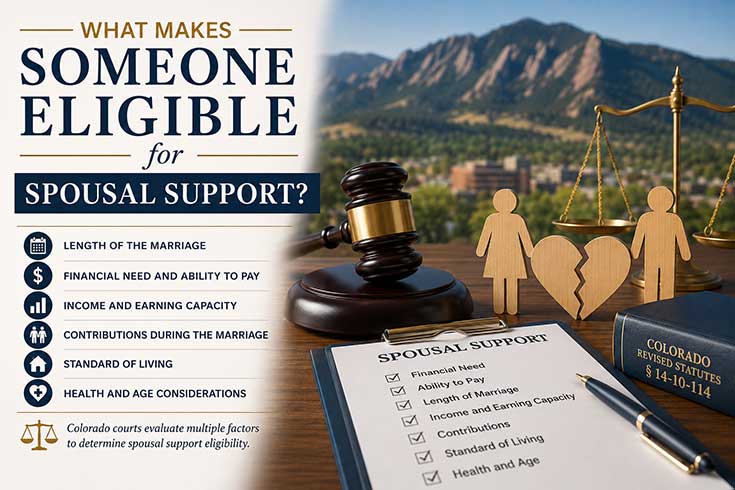
Courts consider factors such as the length of the marriage, each spouse’s income and earning capacity, and the standard of living during the marriage. A skilled divorce attorney in Boulder can help spouses understand how these factors may apply to their circumstances.
No single factor guarantees an award of spousal support. Here are the key factors that can affect eligibility:
Length of the Marriage
One of the most significant factors courts consider is the duration of the marriage.
Generally, longer marriages are more likely to involve spousal support considerations because spouses often become financially intertwined over time. In some relationships, one spouse may have sacrificed career opportunities, education, or earning potential to support the household or raise children.
As the length of the marriage increases, courts may be more inclined to consider whether financial assistance is necessary to help a lower-earning spouse transition after divorce.
Financial Need of One Spouse
Eligibility for spousal support often begins with a demonstrated financial need.
A spouse seeking support may need to show that their income and assets are insufficient to maintain a reasonable standard of living following the divorce. This does not necessarily mean the person is unable to work. Instead, the court evaluates whether there is a meaningful disparity between the parties’ financial situations.
The greater the economic imbalance, the more likely support may become an issue in the case.
Ability of the Other Spouse to Pay
Need alone is not enough. Courts also examine whether the other spouse has the financial ability to provide support.
Factors such as income, assets, employment status, and financial obligations may all be considered. Even when one spouse demonstrates financial need, support may be limited if the other spouse lacks sufficient resources.
The court’s goal is often to balance the interests of both parties while considering their respective financial realities.
Differences in Income and Earning Capacity
In many divorces, one spouse earns significantly more than the other. Courts frequently examine both current income and future earning potential when determining whether support may be appropriate.
For example, one spouse may have spent years building a successful career while the other focused on managing the household or caring for children. In these situations, the lower-earning spouse may face challenges becoming financially self-sufficient immediately after the divorce.
The court may consider these disparities when evaluating eligibility and determining the amount of support.

Contributions Made During the Marriage
Financial contributions are not the only contributions that matter in a marriage.
Many spouses provide substantial non-financial support by caring for children, managing the home, supporting a partner’s education, or helping a spouse advance professionally. These efforts can play an important role in the court’s analysis.
A spouse who contributed significantly to the family’s well-being may be viewed differently than someone whose circumstances were substantially different during the marriage.
Standard of Living Established During the Marriage
Courts often consider the lifestyle the parties enjoyed while married.
Although divorce usually requires financial adjustments for both spouses, judges may evaluate whether support is necessary to help maintain a reasonably comparable standard of living, particularly when there is a significant difference in post-divorce earning abilities.
This factor is frequently considered alongside income, assets, and future earning potential.
Health and Age Considerations
A spouse’s age and health can also affect eligibility.
Individuals dealing with medical conditions, disabilities, or age-related limitations may face greater difficulty becoming financially independent after a divorce. Courts may take these circumstances into account when assessing both the need for support and the duration of any award.
These personal factors can have a substantial impact on the outcome of a spousal support determination.
How Colorado Courts Evaluate Spousal Support
Colorado law provides guidance regarding maintenance awards in divorce cases. Under Colorado Revised Statutes § 14-10-114, courts may consider factors such as the financial resources of each spouse, the marital standard of living, the duration of the marriage, and the ability of the paying spouse to meet both parties’ reasonable needs.
Because the law requires a detailed evaluation of multiple factors, eligibility is determined on a case-by-case basis rather than through a simple formula alone.
Key Takeaways
- Spousal support is often based on one spouse’s financial need and the other spouse’s ability to pay.
- The length of the marriage can play a significant role in eligibility determinations.
- Courts consider differences in income and future earning capacity.
- Non-financial contributions to the marriage may influence support decisions.
- A spouse’s age, health, and ability to become self-supporting can affect eligibility.
- Colorado Revised Statutes § 14-10-114 provides important guidance for maintenance determinations.
- Consulting a skilled divorce attorney in Boulder can help individuals understand how spousal support laws may apply to their specific circumstances.

Speak Your Mind