


Stump grinding on an operating commercial property is a scheduling and liability exercise that happens to involve a machine. The work takes place near tenants, customers, parked vehicles and buried services, and each of those carries a cost if something goes wrong.

The job is typically run as a staged operation with paperwork at each step, and most of the risk is settled before the grinder starts.
Why the stump becomes a liability once the tree is down
Tree removal takes down the canopy and the structural trunk, and the stump that remains sits outside the scope of that work. On a commercial site, that stump creates a trip hazard in pedestrian areas and a mowing obstruction in landscaped ones. It also reads as unfinished maintenance to tenants, customers, contractors and anyone assessing how the property is managed. Regular landscaping and tree maintenance are important for maintaining property value and curb appeal, whether the property is residential or commercial.
Decaying stumps attract termites and carpenter ants, and colonies established in dead wood can move toward buildings. Fungal organisms such as Armillaria colonize rotting stumps and can spread through soil to healthy trees nearby. Grinding removes the food source that supports both the pests and the fungal pathogen.
A stump doesn’t always stay dead, and some species send up shoots that need repeated cutting. It also blocks future works, because nothing can be paved, planted, fenced or built over it until the wood is gone. Insurers treat a known trip hazard as a foreseeable risk, and a stump in a walkway fits that description.
In car parks, surface roots and stumps damage tires and mower decks, and the repair invoices arrive at the manager’s office. Grinding costs are fixed and quoted upfront. A claim against the property has no such ceiling.
Start with an underground utility search
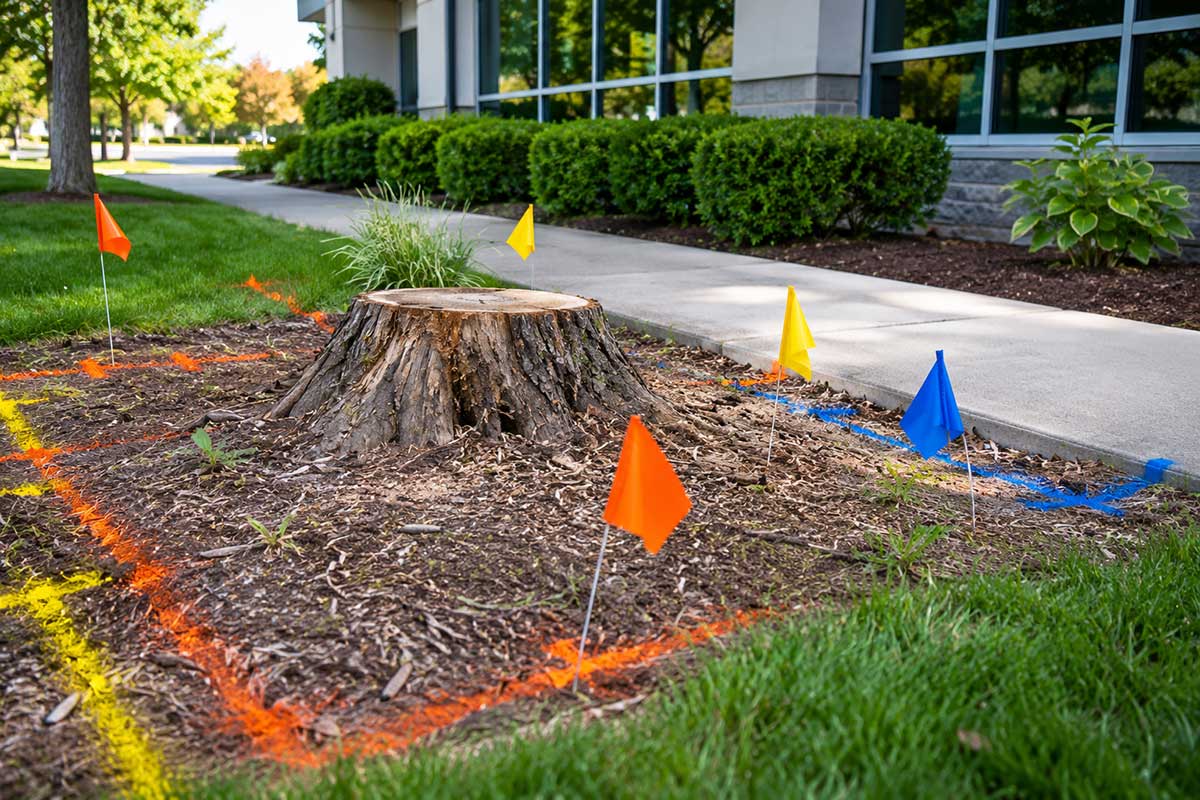
Before any machine is booked, find out what lies below the stump. Grinding teeth work below the surface, and tree roots frequently grow around pipes and cables laid decades earlier. A current utility search is the starting point, because a grinder can’t tell root wood from a fiber optic line.
Property managers typically request plans through a before-you-dig notification service before any work is scheduled. Plans more than a year or two old are treated with caution, because services get added to commercial sites over time.
Gas, water, electricity and telecommunications lines can all intersect a root zone on a developed site. Private services sit outside those plans, and irrigation lines, landscape lighting, car park power and fire services fall to the manager’s own records. Known asset locations are marked on the ground with paint or flags before the grinder is unloaded from the truck.
Where plans are old or incomplete, managers commission a locating contractor to scan the area, and the scan joins the job file. A strike on a live line can stop work across the whole site and bring costly repairs.
Plan the job in two phases, from tree removal to grinding
With the underground picture established, the work itself splits into two phases that are scoped and priced separately. Canopy removal and stump grinding each use different machinery and different crew skills. The first phase brings down the branches and trunk, and the second brings a stump grinder to the root ball below ground level.
Quotes for commercial work usually list the two phases as separate line items, priced on stump diameter, access, depth and cleanup. Some managers bundle both phases with one contractor, and others stage them weeks apart to suit the site. Managers arranging scope and scheduling can consult a reference such as tree lopping toowoomba when setting out any branch work in the first phase. In the second phase, a commercial-grade grinder addresses the subsurface root ball and the liability attached to it.
The root flare and lateral roots extend well beyond the visible stump, sometimes several meters on mature trees. That underground spread is what the grinding phase has to address, and it shapes later decisions about access, utilities, scheduling and reinstatement. The trunk is cut low during the first phase when grinding is planned, because a low stump takes less machine time.
The gap between phases has its own cost on a live site, because a felled trunk and a standing stump each need their own barricading. Running the phases on consecutive days means the exclusion fencing goes up once instead of twice.
Ask for a risk assessment and a method statement
Before work begins, ask the contractor for a site risk assessment and a safe work method statement. The assessment identifies the hazards expected on the day, including flying debris and machinery movement, and the method statement sets out the controls applied to each one.
Flying debris leads most statements, because grinder teeth throw wood chips and small stones at considerable speed. Guards and screens on the machine catch most of it, which is why the exclusion zone matters for what gets past them.
The statement names the people doing the work and the supervisor responsible, and the manager countersigns it before work starts. Workers carry the tickets and licenses the statement lists, and managers can ask to see them on the day.
Public liability insurance sits alongside that paperwork, and a certificate of currency shows the policy is active on the day the work takes place. Site managers can ask the contractor and the insurer what cover the site requires and what the policy holds.
On the day, the exclusion zone is where the method statement gets applied. The contractor sets the size and layout of that zone to suit the site, using temporary fencing and signage around the active grinding area. A spotter covers any pedestrian approach that fencing can’t close, and work pauses when someone enters the zone.
Schedule around tenants and trading hours
Local councils set noise rules that restrict the hours when loud machinery can operate, and stump grinders fall within those limits. Facility managers usually check the permitted hours first and then look for a window inside them that suits the site. Early mornings, weekends, public holidays and scheduled shutdowns are the windows most often used on operating commercial properties.
Written notice to tenants before the work date reduces complaints and gives businesses time to move vehicles or adjust deliveries. Notice periods vary by site, and a week is the span managers commonly give tenants before machinery arrives. A retail strip faces different pressures from an office park, and the notice reflects who uses the site and when.
Parking bays inside the exclusion zone are lost for the duration, and the schedule needs to account for that loss. Deliveries, bin collections, contractor visits and customer parking are checked against the work window so the site doesn’t stall itself. Wet weather changes ground conditions and access, and a reschedule clause in the booking prevents a difficult morning call.
Some managers split the work across two short visits when one long visit would close too much of the site. The arborist’s availability and the tenant calendar need to line up before a date is confirmed. Noise carries further in the early morning, and managers weigh that against the benefit of an empty car park.
Match the grinder to the access route
Stump grinders range from compact walk-behind units that fit through a standard gate to track-mounted machines that need vehicle access. Gate widths, steps, paved surfaces and overhead clearance are all checked before a machine is nominated for the site, usually at the quoting stage. This prevents a machine arriving that can’t reach the stump.
Track-mounted units suit open sites with firm ground, and pedestrian units suit confined courtyards and garden beds. A site with several stumps changes the calculation, because one larger machine can finish a group in less time than a small unit. The arborist can price both options where the access route allows a genuine choice between them.
Tight access through a building or down a side passage can rule out larger machines entirely on some sites. Where that happens, the quote reflects the smaller machine and the longer time the work will take. The machines run on petrol or diesel, and refueling happens off finished paving to avoid stains.
Heavy machinery compacts soil, and soil compaction damages the root zones of nearby landscaping the property intends to keep. Operators lay track mats or plywood sheets across soft ground and finished paving to spread the load. The route from the street to the stump needs the same planning as the grinding itself.
Agree on ground reinstatement before work starts
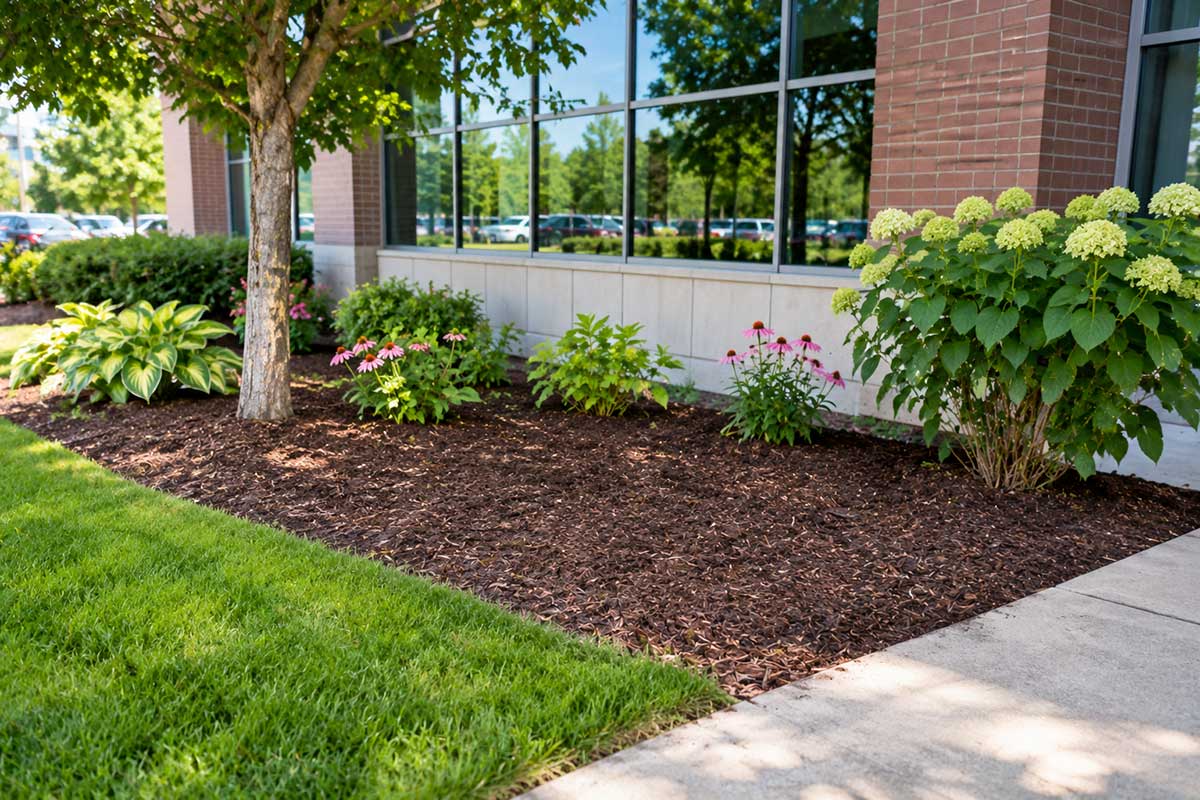
Grinding turns the stump and upper roots into mulch, and it leaves a hole where the root ball sat. Grinding depth is agreed in advance, and deeper grinding costs more because the machine works longer below grade. A site bound for paving needs a deeper grind than one bound for lawn, and the quote should state the depth.
Backfill specifications depend on the intended surface. A soil and mulch mix suits lawn or garden beds, but wood chips are not structural fill and cannot carry paving. Contractors should specify reinstatement matched to the planned surface, with engineered preparation where paving is intended. Sinkage appears weeks later when fill is placed without compaction, and the repair costs more than doing it properly once.
The mulch volume surprises first-time managers, because a large stump produces several cubic meters of material. Some sites keep the mulch for garden beds and others have it removed, and the quote states which applies. Replanting in the same spot is possible after deep grinding, and an arborist can advise on species that suit the space.
The reinstatement method belongs in the quote, because it determines what the surface can become afterward. Photographs of the area before and after the work close out the file for the property manager.
After the grinder leaves, the file holds the utility plans, the method statement, the insurance certificate and the photographs. That record is what gets produced when an insurer, a tenant, a valuer or head office asks questions months later. The practical next step is a site walk with a qualified arborist, and the points above form the agenda for it.

Speak Your Mind